Medical images for research, de-identified and encrypted in your browser.
Yggdrasil is an open-source platform to collect, view, annotate, process and export imaging data. The server stores ciphertext: only the members of a project can read its images and annotations.
This installation is run by Università degli Studi di Modena e Reggio Emilia. Developed by AImageLab, University of Modena and Reggio Emilia.
We store data we cannot read
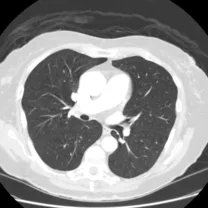
Your files are de-identified and encrypted in your browser before anything is uploaded. Here is what happens to one CT series.
On your computer
A CT series as the scanner wrote it: names and IDs in its headers.
In your browser
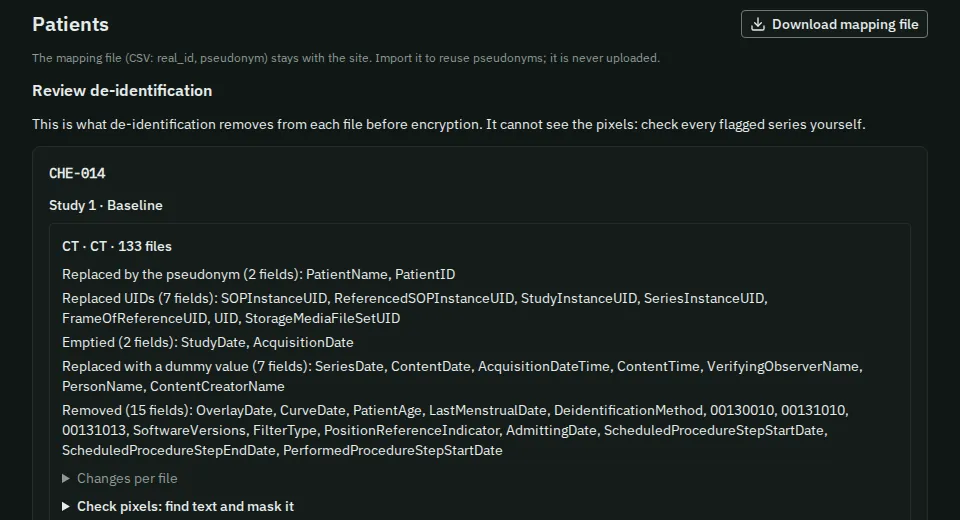
Identifying tags are removed and the patient gets a pseudonym. You review what changes, then every file is encrypted with the project's key.
- PatientName and PatientID are replaced by the pseudonym CHE-014.
- PatientBirthDate and StudyDate are emptied; InstitutionName is removed.
- The image and the remaining tags are encrypted with the project's key.
On the server
Ciphertext only. The server sees sizes, counts and timing, never names, pixels or annotations.
What the design guarantees
- Identifying metadata is removed on your device before anything is uploaded: DICOM follows the PS3.15 Annex E profile; other formats lose their header text, embedded metadata and original file names.
- Each project has its own key. Only members' devices hold it, unlocked by a known device or a passkey. Signing in with an email code never unlocks data.
- Processors receive keys only for the inputs of their jobs, unless a project admin grants more, which every member sees.
- The encryption format is published with test vectors and uses audited libraries only.
The honest limits
- The operator sees sizes, counts, timing, modality types, task progress and the other metadata the specification lists, but not the content.
- Identifying text burned into pixels, or a face in a head scan, is the uploader's to remove. The upload screen flags the known risks.
- Exports leave the encryption on purpose: an export worker decrypts what an admin chose into a plain archive, kept until its link expires.
- Every member of a project holds its key; a removed member may keep data they had already opened.
- The server delivers the web app, so a malicious operator could ship altered code. Self-hosting removes that trust.
- If every admin of a project loses access to their keys, nobody can recover the data, AImageLab included.
How it works
One project, five steps. A versioned manifest says which modalities the project accepts, which tasks its annotators see and which processors run; each page of the app has a guided tour.
Collect
Drop files or folders. The browser groups them into patients, studies and series, removes identifying metadata, shows you what it removed, then encrypts and uploads.
View
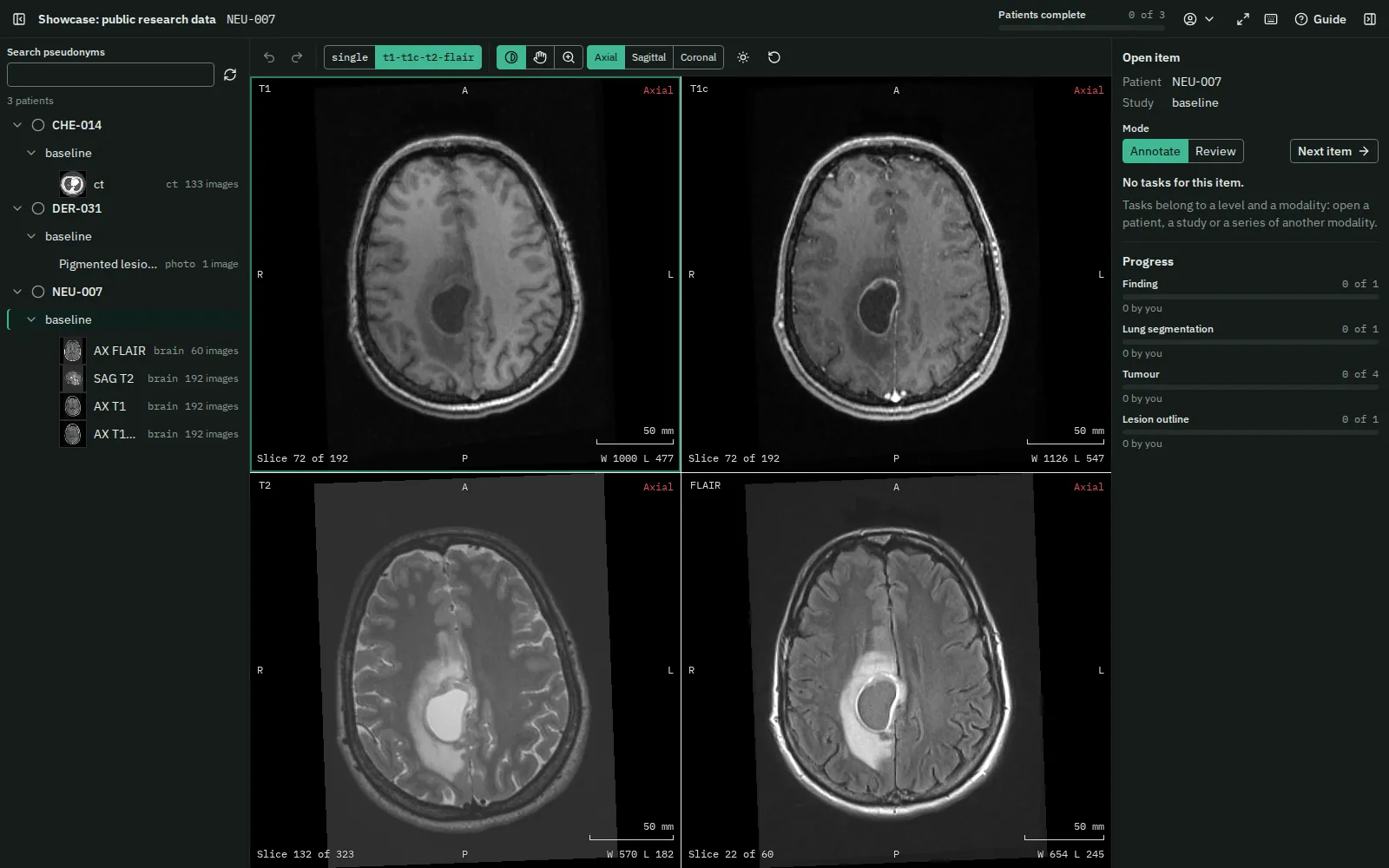
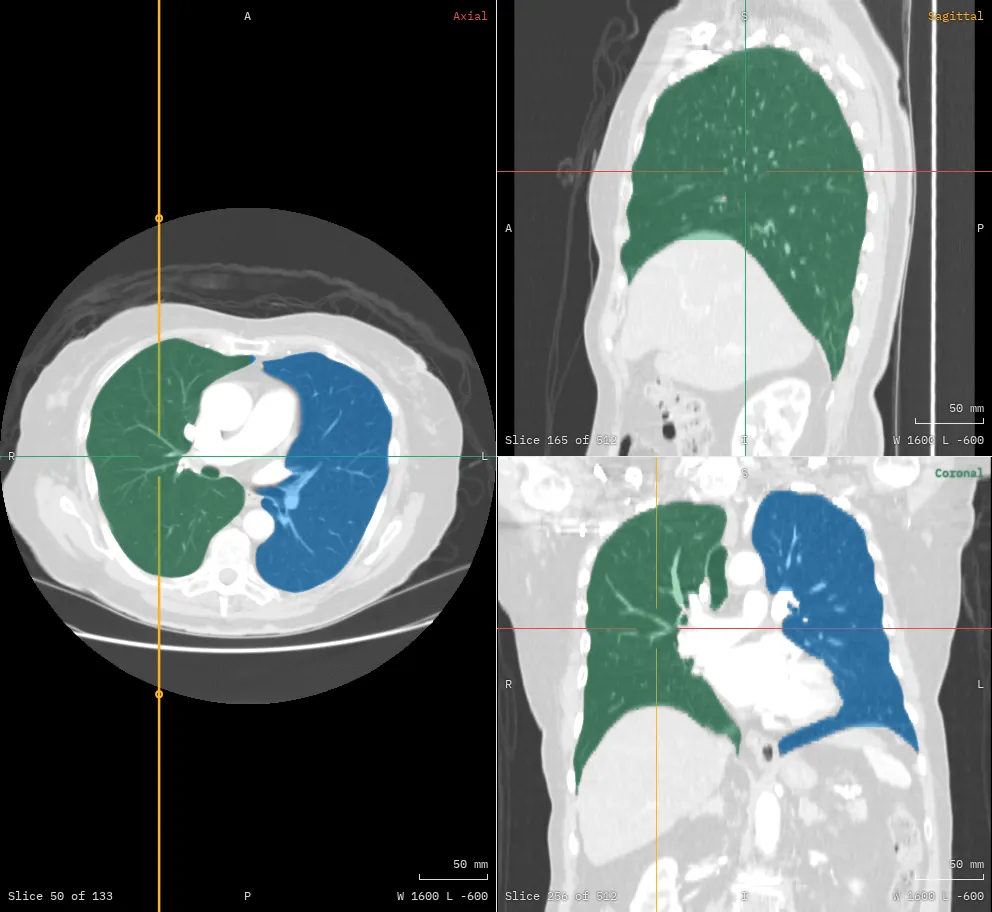
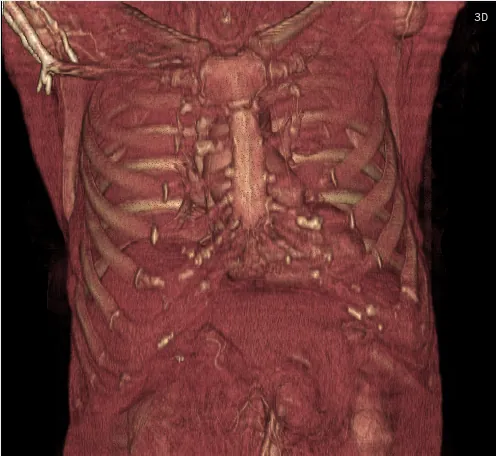
Volumes open in multiplanar views with crosshairs, a volume rendering and hanging protocols; 2D images and forms open beside them. Decryption happens in the browser.
Annotate
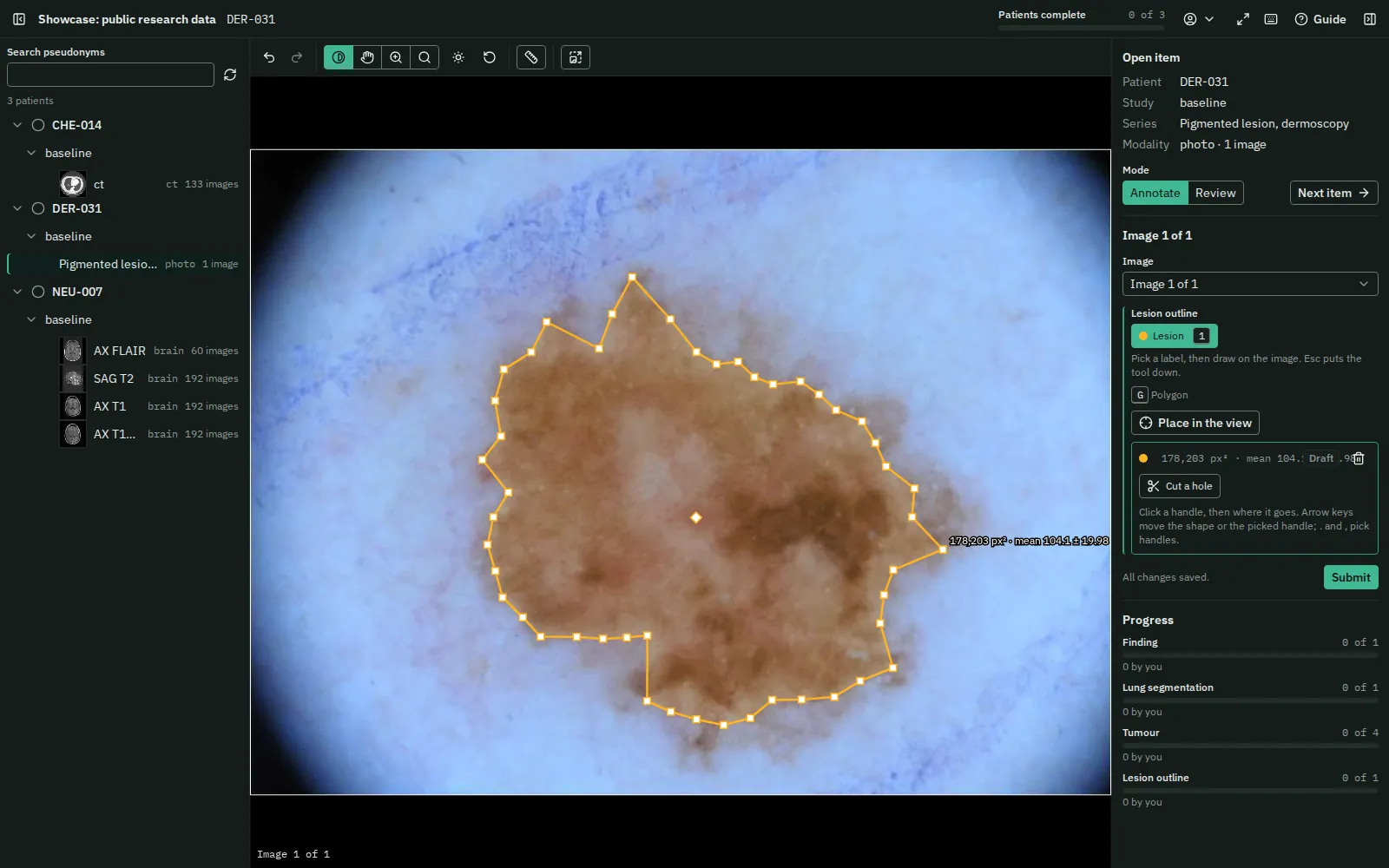
The project's tasks sit next to the image: choices, scales, measurements, shapes and segmentations, each with its guideline. Work saves itself, and other annotators can correct it.
Process
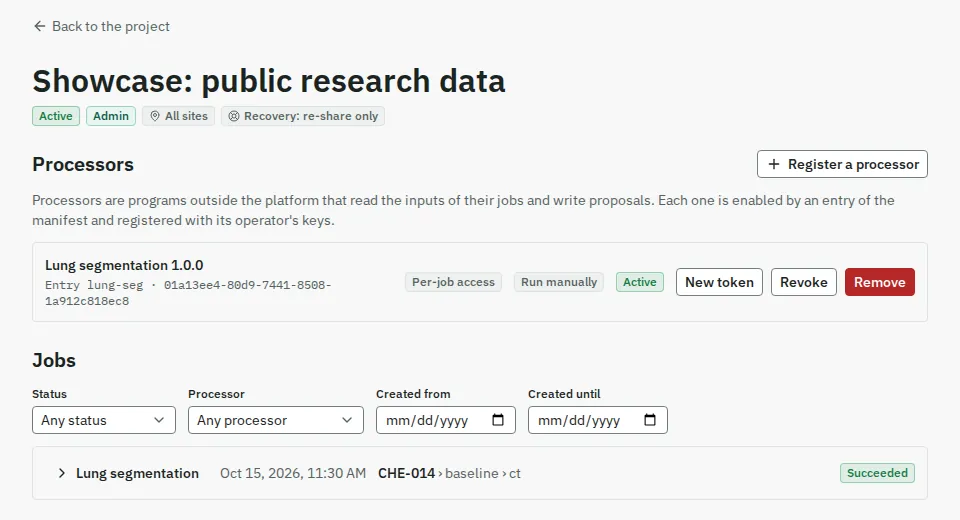
Processors, your models on your machines, claim jobs over HTTPS, decrypt only the inputs they are granted, and post results as proposals for people to correct.
Export
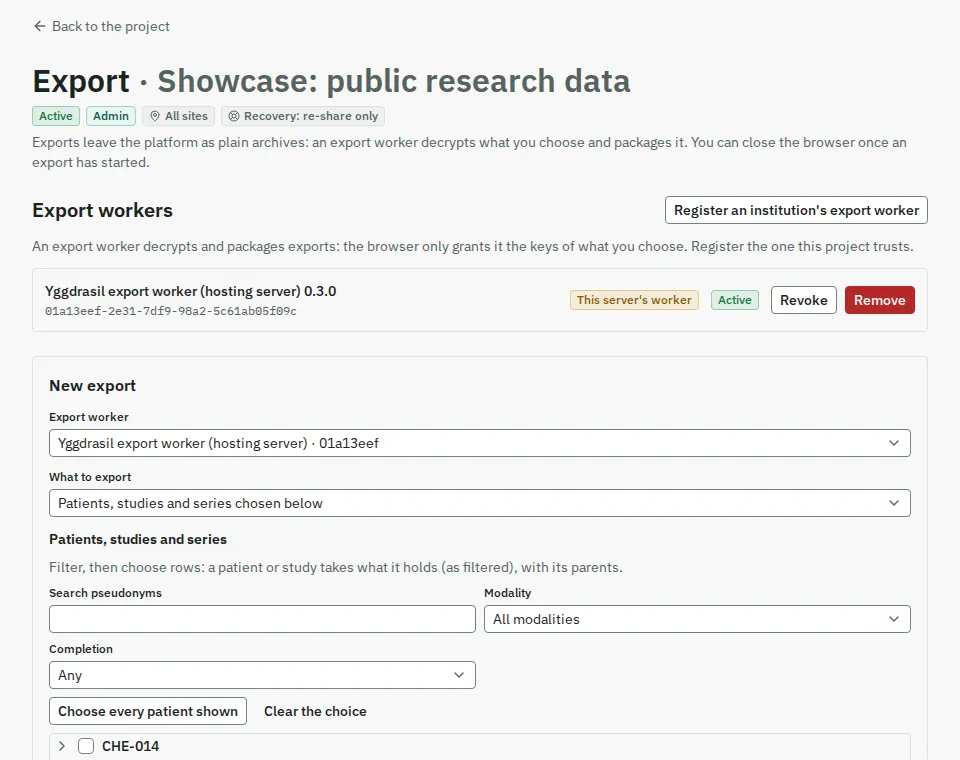
An export worker the project trusts decrypts what an admin chooses into open formats such as DICOM SEG, NIfTI, nnU-Net and COCO, with a dataset card, behind a link that expires.


Modalities and annotation types
Modalities and annotation types are plugins with a public contract, so new ones do not change the core. These pictures are the app on public research data.
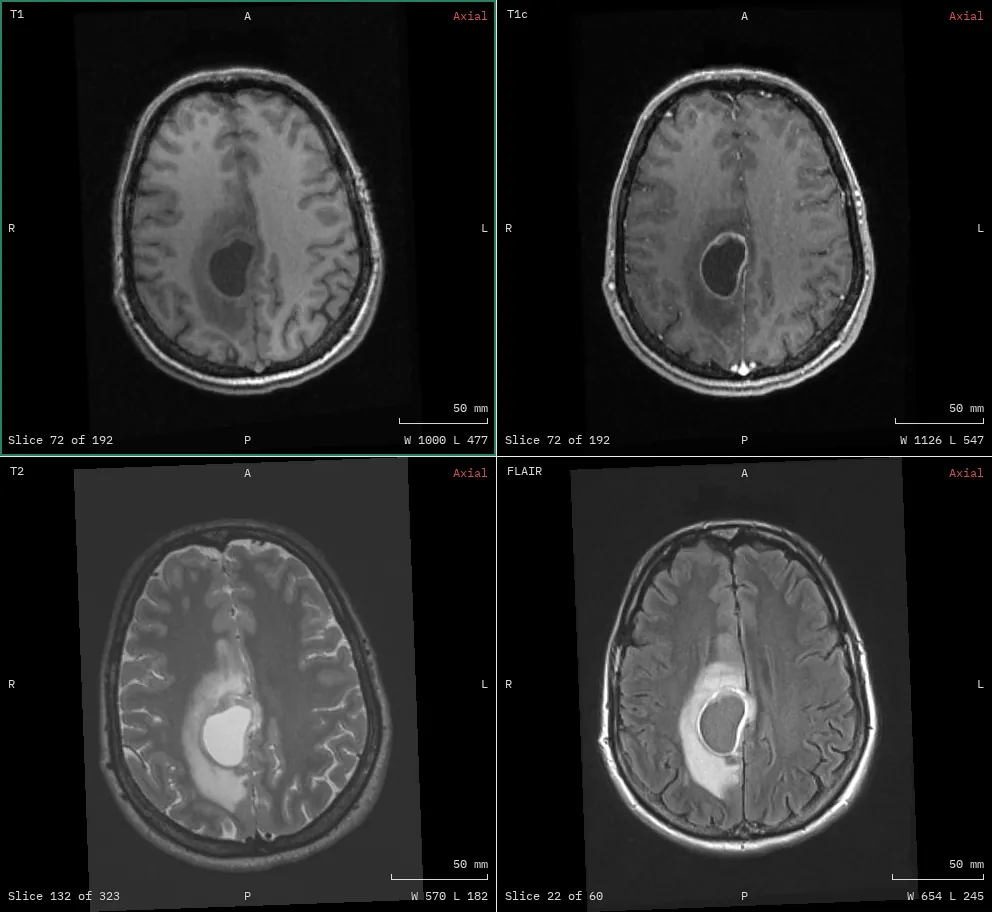
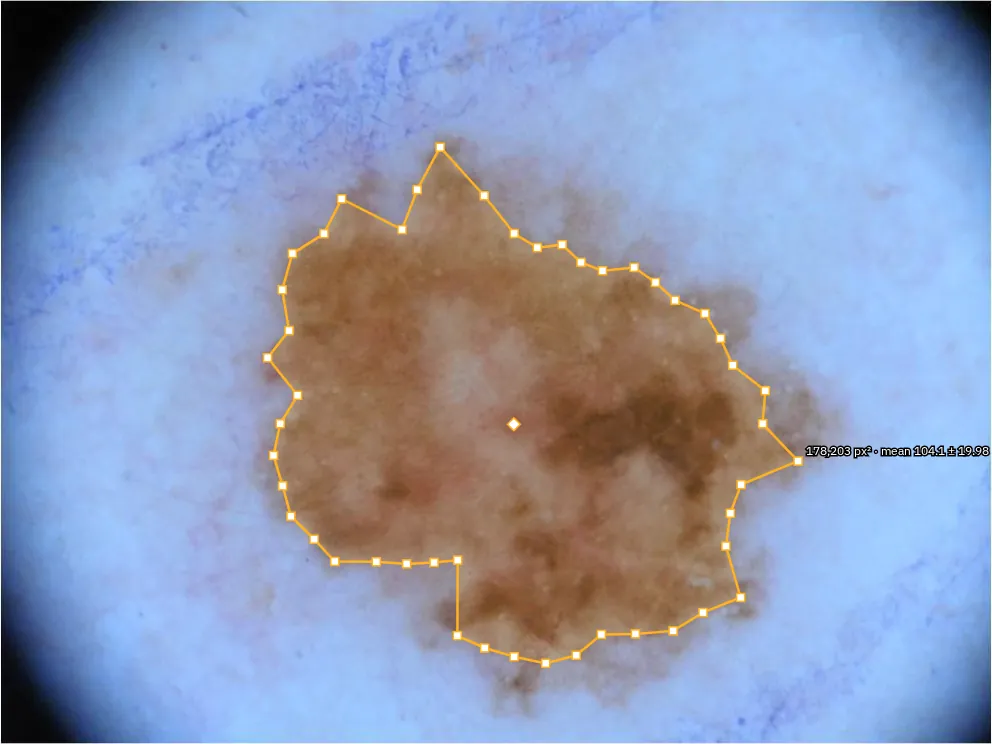
Modalities
- Volumes
- CT, MRI, CBCT and PET/CT, from DICOM, NIfTI or NRRD
- 2D images
- Radiographs, panoramic and cephalometric images, mammograms, photos
- Forms
- Clinical forms for a patient or a visit, with or without images
Annotation types
- Classification
- Single and multiple choice, yes or no, ordinal scales
- Values
- Free text, numbers with a unit
- Geometry
- Points, boxes, polygons, in 2D and on volumes
- Segmentation
- Labelmaps painted with brushes, thresholds and interpolation
Use it
Request a project here
Each installation belongs to one institution and holds only that institution's projects; partners from elsewhere join them as invited members. This one is run by Università degli Studi di Modena e Reggio Emilia. Storage, members, processors and duration are agreed for each project.
The form asks about you, the project, its modalities, data volume, annotators, ethics approval and duration. Your email is verified with a code. Every project admin and uploader is responsible for the data they upload, including its de-identification and its legal basis.
Run your own
Another institution runs its own installation of the same release, with no closed features: one machine with Docker Compose, its own storage and its own keys. Its data never reaches this one.
How to cite
No paper describes Yggdrasil 4 yet. Until one does, cite the software.
The citation metadata is in CITATION.cff; GitHub offers it in APA and BibTeX under "Cite this repository".
# Citation metadata (https://citation-file-format.github.io), shown by GitHub as "Cite this repository".
cff-version: 1.2.0
message: "If you use Yggdrasil in your research, please cite it as below."
type: software
title: "Yggdrasil by AImageLab"
abstract: >-
  An open-source platform to collect, view, annotate, process and export 2D and
  3D medical images. Files are de-identified and end-to-end encrypted in the
  browser, so the hosting operator stores only ciphertext.
authors:
  - name: "AImageLab, University of Modena and Reggio Emilia"
    website: "https://aimagelab.unimore.it"
repository-code: "https://github.com/lorenzobrg/yggdrasil4"
license: AGPL-3.0-only
keywords:
  - medical imaging
  - annotation
  - DICOM
  - end-to-end encryption
  - de-identification
Team, partners and sponsors
Team
Yggdrasil is developed by AImageLab, University of Modena and Reggio Emilia.
- Lorenzo, Lead developer
- Omar Carpentiero, Maintainer
Sponsors and funding
Donations and sponsorships fund development. Sponsors at the Supporter, Lab and Institution tiers are listed here and in the README, never inside the annotation workspace, and sponsorship confers no control over the roadmap.
To sponsor the project, contact AImageLab.
Licensing
Research use is free under the AGPL-3.0. Companies support development and hosting through sponsorship. For a use the AGPL does not fit, such as a closed product, AImageLab offers a separate licence, agreed case by case.
For a separate licence, contact AImageLab.